How to deploy your founder story (even if you've never shared it before)

Your founder story exists. You just haven't deployed it yet.
Last week I explained why founder stories matter. They're proof your mission isn't theoretical. The poll I sent to my newsletter subscribers confirmed what I've been seeing for months. Three-quarters of charity CEOs have never shared their founder story publicly.
The gap isn't desire. It's deployment.
Most founders I work with freeze at the same point. They understand why their story matters. They know it could build trust with funders. They've even drafted something in their head.
But they don't know how to share it without making themselves vulnerable in ways that feel unsafe. They don't know which format to use. They don't know where to start.
So they don't start at all.
The deployment ladder nobody talks about
Here's what most people get wrong. They think sharing your founder story means one big reveal. A TED talk. A Guardian feature. A viral LinkedIn post.
I'd recommend that those shouldn’t be the first places you share your story.
I've delivered 80+ public talks about founding my charity, Naz and Matt Foundation. But I didn't start there. Sadly, because of the tragedy that led me to start my charity, it was pretty public. Very public. The first time I shared our story in public, it was live on Sky News at breakfast. Then on BBC News.
I wouldn't recommend you do it that way.
Using knowledge gained over the past 11 years, I've developed a founder story ladder to guide you. A way to start small, test what works, and build confidence before you go public.
Why founders avoid this work
I need to be honest about something. Sharing your founder story will cost you.
When I started sharing ours, I was also dealing with immeasurable grief, PTSD, trauma, and trying to cope with the impact of our very private lives suddenly becoming public. I hated the vulnerability. And there was no way to escape from the visibility
But I kept doing it because the story helped people. LGBTQ+ individuals found our support services because they heard the story and recognised their own lives in it. And over time, policymakers, politicians, government agencies, and funders came to understand why we existed rather than just what we did.
The cost was real. But so was the impact.
I'm not recommending you follow my path at all. In fact, I'm recommending the complete opposite. I’m sharing my experiences to help guide you toward a safer, calmer, and more pragmatic approach to sharing your story.
If you're hesitating to share your founder story, that hesitation isn't weakness. It's wisdom. You're protecting something sacred. The question isn't whether to protect it. The question is whether keeping it hidden is serving your mission.
Start where it feels safest
You don't need to share your founder story publicly to make it useful.
Start with your team. Tell them why you founded or joined the organisation. What happened in your life that made this mission feel non-negotiable. What you hope they understand about why this work matters to you personally.
That conversation changes how they see the organisation. It changes how they talk about your work to others. It changes how they understand the stakes.
Then expand to your board. Then to major donors in one-to-one conversations. Then to funding applications where your lived experience demonstrates you understand the problem deeply.
Only after you've tested it in controlled environments do you consider going public.
The magnetic effect happens at every level
You don't need a million-view LinkedIn post for your founder story to work.
When I mention in a funding application that I founded Naz and Matt Foundation after my fiancé died by suicide, that single sentence changes how funders read everything else. They understand our mental health work isn't abstract. They understand why LGBTQ+ support matters to us specifically.
That's the magnetic effect at work. Your story pulls people toward your mission because they understand it's rooted in something real.
This works in board meetings. In donor conversations. In team recruitment. In partnership discussions.
You don't need scale. You need strategic deployment in the moments that matter most.
What deployment actually looks like
Over 11 years, I've shared our founder story across every format you can imagine.
Guardian features. BBC interviews. Two Channel 4 documentaries. Government training sessions. Police workshops. Charity conferences. LinkedIn posts. Funding applications. Partnership pitches. Podcasts. Poems. Folk songs. School talks. Books.
Each format served a different purpose. Each reached different audiences. Each created different outcomes.
An audience that sees your LinkedIn post isn't necessarily the same as the audience that sees a documentary on Channel 4. Appearing on BBC World News isn't necessarily going to connect you to the same people who would attend a police training workshop.
You need multiple formats. Not because one isn't enough. But because different audiences need different entry points.
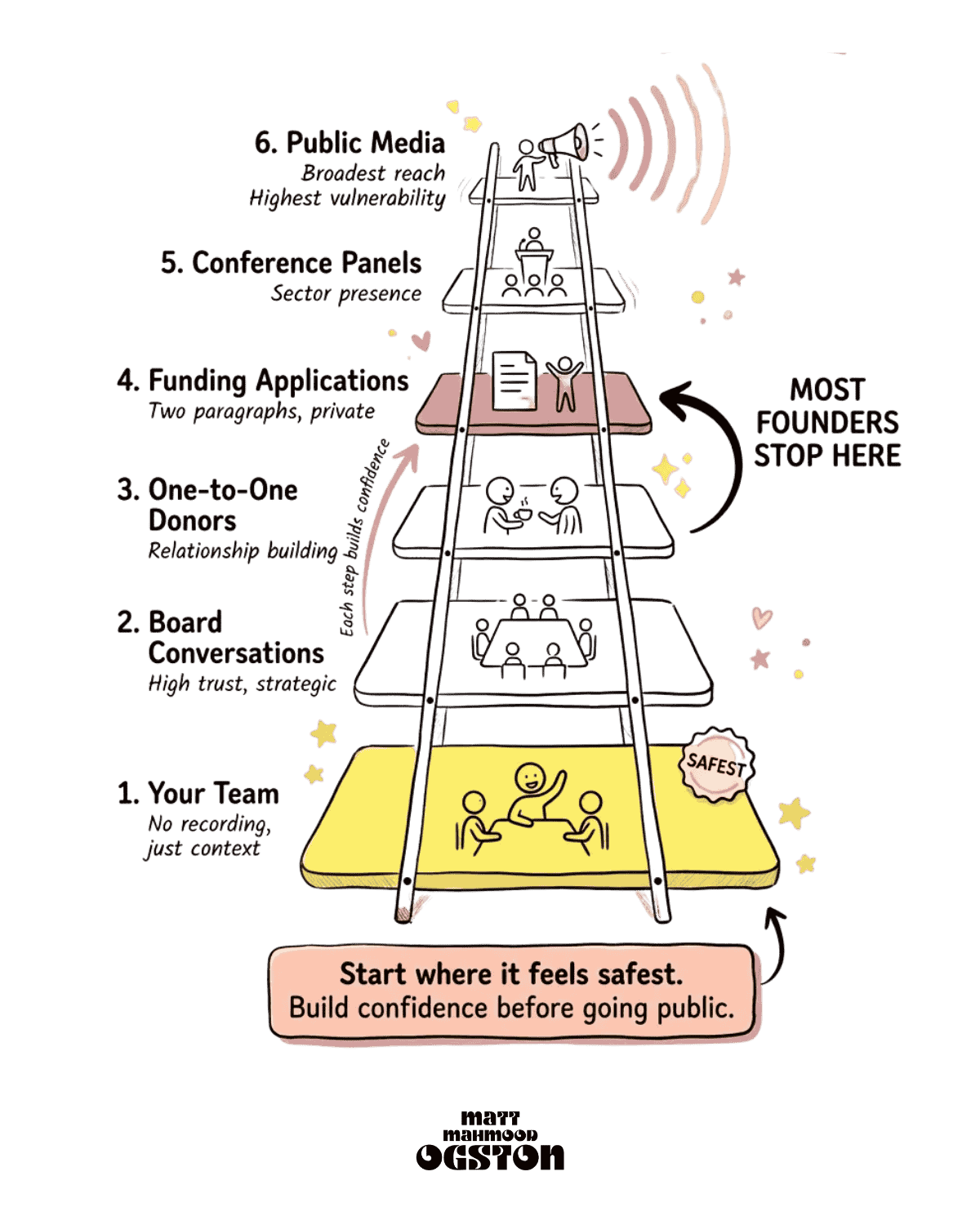
The Founder Story Deployment Ladder
Where most people get stuck
The biggest barrier isn't writing your founder story. It's choosing where to deploy it first.
So here's my advice after 11 years of doing this badly before doing it well.
Start with the format that feels lowest risk and highest value. For most charity founders, that could be a funding application. You're already writing them. You already have to explain why you're qualified to do this work. Your founder story answers that question.
Add two paragraphs. One about what led you to start the organisation. One about why that personal connection strengthens your approach.
That's it. No LinkedIn post. No press release. Just two paragraphs in a document only the funder sees.
If that feels manageable, you're ready.
Want the practical tools for deploying your founder story?
This article is an extract from the Social Impact Storyteller, my weekly newsletter for charity leaders and social impact professionals.
Every Thursday, I send one storytelling idea and three ways to implement it:
One framework
One template
One AI prompt
This week's full edition includes:
The Founder Story Deployment Ladder in full detail (6 progressive levels from safest to most public)
Your First 500-Word Founder Story Structure (fill-in template)
AI prompt to adapt your story across formats (funding applications, LinkedIn, one-sentence bios)
Early access to The Founder Story Sprint (4-week programme launching soon)
Subscribe here to get the full toolkit.
Did I mention, it's free?
https://www.impactstoryteller.org/
Matt Mahmood-Ogston Award-winning impact storyteller, documentary photographer and charity CEO Founder, Naz and Matt Foundation